Modern refrigerators may contain flammable refrigerant
Many newer household refrigerators use hydrocarbon refrigerants such as R-600a, also known as isobutane. Some refrigeration applications use R-290 propane. Not every refrigerator uses a flammable refrigerant, so the correct starting point is the appliance data plate—not an assumption.
The U.S. Environmental Protection Agency identifies R-600a and R-290 as flammable alternatives that are acceptable only under specified use conditions. They can be safe inside equipment designed for them, but a service procedure that releases refrigerant, creates a spark, applies heat, or uses incompatible tools can introduce a fire risk. See the EPA household-refrigeration refrigerant guidance.
Refrigeration repair is a different specialty
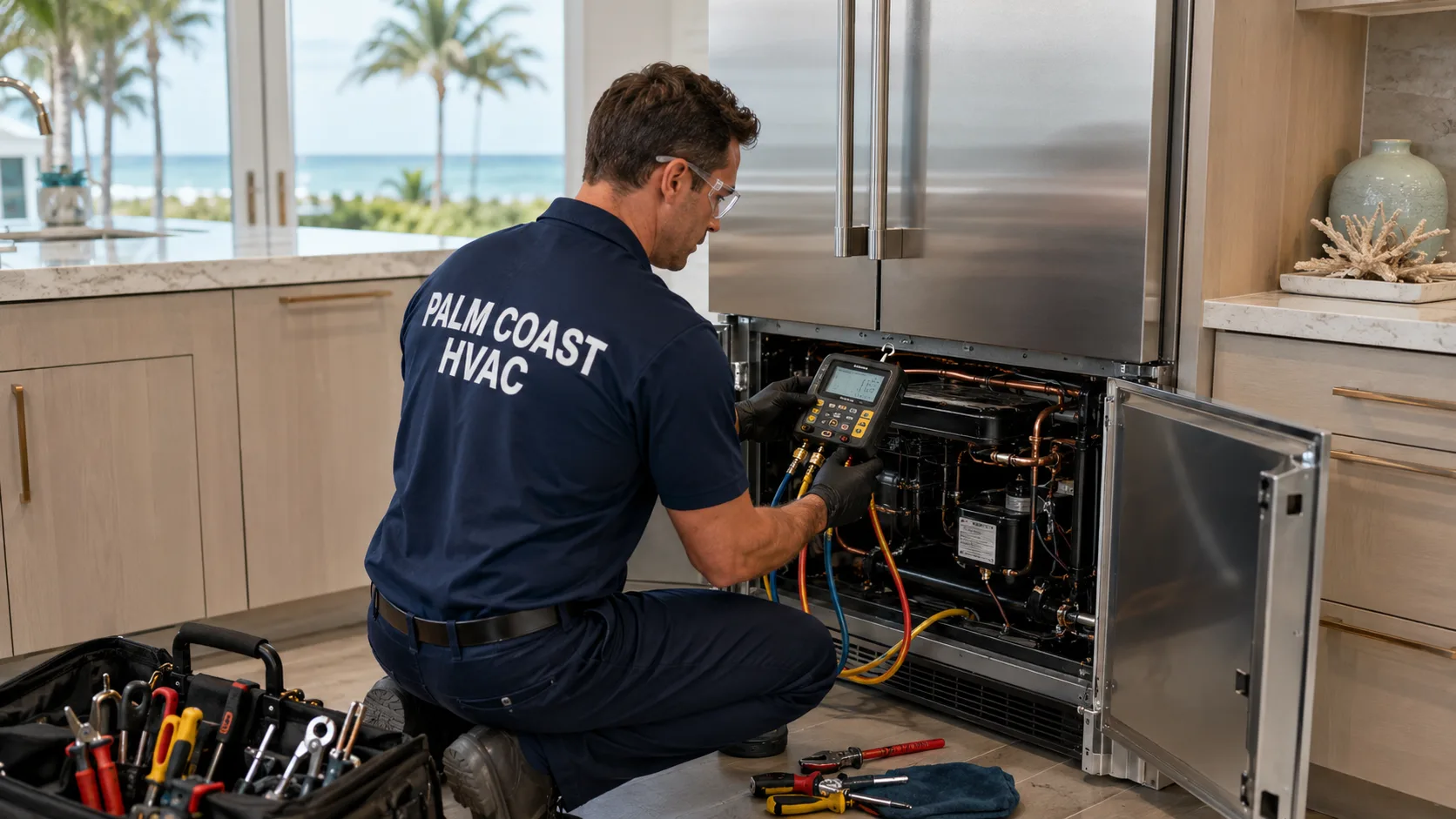
A washer or dryer technician may be highly capable within that trade. However, sealed-system refrigerator work requires a different combination of knowledge and equipment: refrigerant identification, electrical isolation, leak detection, pressure and temperature analysis, evacuation, accurate charging, brazing or approved connection methods, and contamination control.
On a premium built-in appliance, an incorrect diagnosis can also damage electronic boards, variable-speed compressors, valves, evaporators, insulation, custom panels, floors, or surrounding cabinetry. Replacing parts without proving the fault can make an expensive problem worse.
Looking for general consumer appliance repair?
Palm Coast Appliances is our consumer appliance repair website for Palm Coast homeowners. Visit it for information about household appliance services beyond specialized HVAC and refrigeration work.
Visit Palm Coast Appliances →Flammable refrigerants change the work area and the tools
Work on a flammable-refrigerant system must follow the manufacturer’s service information and the procedures appropriate to that refrigerant. That can include controlling ignition sources, ventilating the work area, using compatible leak-detection and service equipment, verifying the refrigerant charge precisely, and confirming system integrity before returning the refrigerator to service.
EPA materials state that only technicians specifically trained in handling flammable refrigerants should service equipment containing them. Recovery equipment and other tools must be suitable for the refrigerant and the work being performed. EPA also specifies standards for refrigerant recovery and recycling equipment.
What licensing and certification actually tell you
Credentials do not guarantee a perfect repair. They do provide meaningful evidence of training, accountability, and familiarity with applicable rules. Where work could open a regulated refrigerant circuit, federal Section 608 rules generally require the appropriate technician certification. The certification type depends on the equipment and work involved. EPA explains the Section 608 technician requirements here.
For high-end home refrigeration, ask whether the provider carries the appropriate contractor license, insurance, EPA certification where applicable, manufacturer service information, and training specific to the refrigerant identified on your appliance. Palm Coast HVAC displays Florida license CAC1824984 on every page so customers can verify who they are calling.
What a careful service call should include
A qualified technician should begin with the model, serial number, refrigerant label, temperatures, error history, airflow, fans, sensors, controls, and electrical measurements. The sealed system should not be opened until diagnostic evidence supports that step. If it must be opened, the technician should follow the manufacturer’s procedure and use refrigerant-compatible tools and materials.
This disciplined process is especially important for Sub-Zero, Viking, Liebherr, Samsung, Miele, Thermador, Monogram, JennAir, Dacor, Fisher & Paykel, True Residential, Perlick, and other premium systems where the appliance and surrounding installation may represent a substantial investment.
Conclusion: choose refrigeration qualifications, not just appliance experience
Your refrigerator protects food, finishes your kitchen, and operates continuously inside your home. When it needs more than a simple shelf, gasket, or cosmetic repair, choose a company with refrigeration experience and the credentials, tools, and refrigerant-specific training appropriate to the job.
A licensed and properly trained provider cannot promise that every failure will be inexpensive or repairable. It can give you a much stronger basis for expecting the work to follow safety rules, protect the appliance, and avoid preventable additional damage.